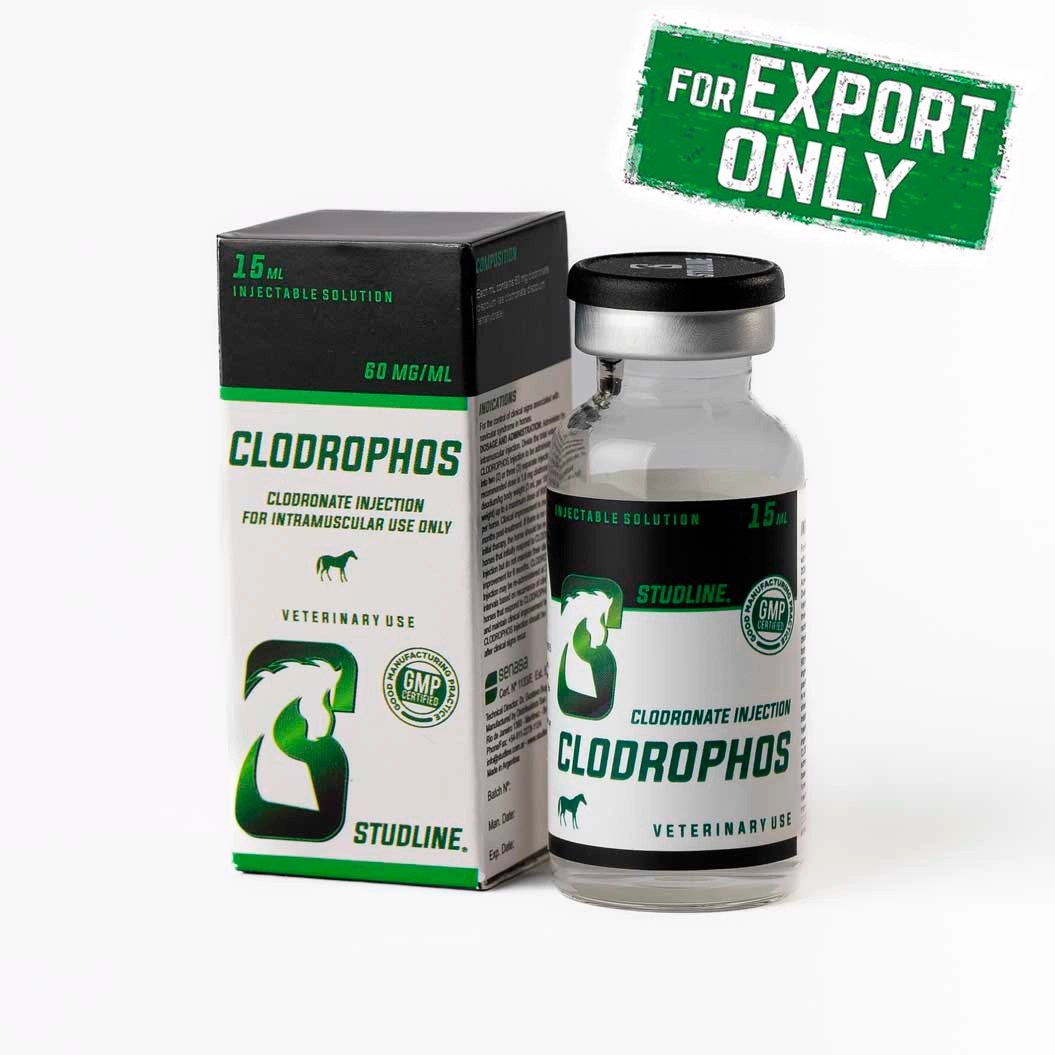
PRODUCT AVAILABLE FOR EXPORT ONLY.
CLODROPHOS® Injection
Clodronate disodium injection, 60 mg/mL
THERAPEUTIC CLASSIFICATION: Bisphosphonate.
DESCRIPTION: Clodronate disodium is a non-amino, chloro-containing bisphosphonate. Chemically, clodronate disodium is a (dichloromethylene) diphosphonic acid disodium salt and is manufactured from the tetrahydrate form.
ACTIVE INGREDIENTS: Each mL contains 60 mg clodronate disodium (as clodronate disodium tetrahydrate)
INDICATIONS: For the control of clinical signs associated with navicular syndrome in horses.
DOSAGE AND ADMINISTRATION: Administer by intramuscular injection. Divide the total volume of CLODROPHOS Injection to be administered evenly into two (2) or three (3) separate injection sites. The recommended dose is 1.8 mg clodronate disodium/kg body weight (3 mL per 100 kg body weight) up to a maximum dose of 900 mg (15 mL) per horse. Clinical improvement is most evident at 2 months post-treatment (see EFFICACY). If there is no response to initial therapy, the horse should be re-evaluated. For horses that initially respond to CLODROPHOS Injection but do not maintain their clinical improvement for 6 months, CLODROPHOS Injection may be re-administered at 3 to 6 month intervals based on recurrence of clinical signs. For horses that respond to CLODROPHOS Injection and maintain clinical improvement for 6 months, CLODROPHOS Injection should be re-administered after clinical signs recur.
CONTRAINDICATIONS: - Do not use CLODROPHOS Injection in horses with known hypersensitivity to clodronate disodium. - Do not use this product in horses with impaired renal function or with a history of renal disease.
CAUTIONS: - The effect of bisphosphonates on the skeleton of growing horses has not been studied. The safe use of CLODROPHOS Injection has not been evaluated in breeding horses or pregnant or lactating mares. - Ensure that horses are adequately hydrated when administering the product. - Concurrent administration of other potentially nephrotoxic drugs should be approached with caution and renal function should be monitored.
WARNINGS: - Keep out of reach of children. - Avoid contact with skin or eyes. Accidental spillage on the skin or eyes should be washed off with water.
INFORMATION FOR HORSE OWNERS: Owners should be advised to observe their horse for at least 2 hours post-treatment for signs of colic, agitation, and/or nervous system abnormalities. If a horse appears uncomfortable, nervous, or experiences cramping post-treatment the owner should be advised to hand walk the horse for 15 minutes until signs resolve. Owners should be advised to contact their veterinarian if the horse displays abnormal clinical signs.
CLINICAL PHARMACOLOGY: Clodronate disodium is a non-nitrogen bisphosphonate that inhibits bone resorption by binding to hydroxyapatite crystals (inhibiting their formation and dissolution), and by exerting direct cellular effects on osteoclasts (inhibiting osteoclast cell function). It has a high afnity for solid-phase calcium phosphate and therefore accumulates in bone. Bound to bone matrix, clodronate disodium enters resorbing osteoclasts, alters their morphology and reduces the number of active osteoclasts, regardless of the cause of osteoclast activity. Clodronate disodium increases bone mass by inhibiting bone resorption and retarding bone turnover. The structural formula of clodronate disodium is: In humans, 60 to 80% of clodronate disodium administered intravenously is eliminated unchanged in the urine and 5% in the feces; the remainder of the dose is distributed to bone. The bone residence time in horses could not be estimated. However, in numerous studies, the half-life of clodronate disodium in rodent bone (long bones and lumbar vertebrae) has been estimated to be months to years. The pharmacokinetic prole of CLODROPHOS Injection after a single intramuscular administration in horses diagnosed with navicular syndrome at doses of 300 mg, 900 mg and 1500 mg of clodronate disodium is characterized by rapid absorption of clodronic acid (0.5-0.7 h) and a longer terminal elimination phase. The area under the plasma concentration-time curve (AUC) and maximum concentration (Cmax) increased proportionally with dosage. A dose of 900 mg administered intramuscularly has a plasma half-life of approximately 5.6 ± 2.6 hours, a Cmax of 7.5 ± 1.7 μg/mL and a time to maximum concentration (Tmax) of approximately 0.6 hours.
PRODUCT AVAILABLE FOR EXPORT ONLY.
CLODROPHOS® Injection
Clodronate disodium injection, 60 mg/mL
THERAPEUTIC CLASSIFICATION: Bisphosphonate.
DESCRIPTION: Clodronate disodium is a non-amino, chloro-containing bisphosphonate. Chemically, clodronate disodium is a (dichloromethylene) diphosphonic acid disodium salt and is manufactured from the tetrahydrate form.
ACTIVE INGREDIENTS: Each mL contains 60 mg clodronate disodium (as clodronate disodium tetrahydrate)
INDICATIONS: For the control of clinical signs associated with navicular syndrome in horses.
DOSAGE AND ADMINISTRATION: Administer by intramuscular injection. Divide the total volume of CLODROPHOS Injection to be administered evenly into two (2) or three (3) separate injection sites. The recommended dose is 1.8 mg clodronate disodium/kg body weight (3 mL per 100 kg body weight) up to a maximum dose of 900 mg (15 mL) per horse. Clinical improvement is most evident at 2 months post-treatment (see EFFICACY). If there is no response to initial therapy, the horse should be re-evaluated. For horses that initially respond to CLODROPHOS Injection but do not maintain their clinical improvement for 6 months, CLODROPHOS Injection may be re-administered at 3 to 6 month intervals based on recurrence of clinical signs. For horses that respond to CLODROPHOS Injection and maintain clinical improvement for 6 months, CLODROPHOS Injection should be re-administered after clinical signs recur.
CONTRAINDICATIONS: - Do not use CLODROPHOS Injection in horses with known hypersensitivity to clodronate disodium. - Do not use this product in horses with impaired renal function or with a history of renal disease.
CAUTIONS: - The effect of bisphosphonates on the skeleton of growing horses has not been studied. The safe use of CLODROPHOS Injection has not been evaluated in breeding horses or pregnant or lactating mares. - Ensure that horses are adequately hydrated when administering the product. - Concurrent administration of other potentially nephrotoxic drugs should be approached with caution and renal function should be monitored.
WARNINGS: - Keep out of reach of children. - Avoid contact with skin or eyes. Accidental spillage on the skin or eyes should be washed off with water.
INFORMATION FOR HORSE OWNERS: Owners should be advised to observe their horse for at least 2 hours post-treatment for signs of colic, agitation, and/or nervous system abnormalities. If a horse appears uncomfortable, nervous, or experiences cramping post-treatment the owner should be advised to hand walk the horse for 15 minutes until signs resolve. Owners should be advised to contact their veterinarian if the horse displays abnormal clinical signs.
CLINICAL PHARMACOLOGY: Clodronate disodium is a non-nitrogen bisphosphonate that inhibits bone resorption by binding to hydroxyapatite crystals (inhibiting their formation and dissolution), and by exerting direct cellular effects on osteoclasts (inhibiting osteoclast cell function). It has a high afnity for solid-phase calcium phosphate and therefore accumulates in bone. Bound to bone matrix, clodronate disodium enters resorbing osteoclasts, alters their morphology and reduces the number of active osteoclasts, regardless of the cause of osteoclast activity. Clodronate disodium increases bone mass by inhibiting bone resorption and retarding bone turnover. The structural formula of clodronate disodium is: In humans, 60 to 80% of clodronate disodium administered intravenously is eliminated unchanged in the urine and 5% in the feces; the remainder of the dose is distributed to bone. The bone residence time in horses could not be estimated. However, in numerous studies, the half-life of clodronate disodium in rodent bone (long bones and lumbar vertebrae) has been estimated to be months to years. The pharmacokinetic prole of CLODROPHOS Injection after a single intramuscular administration in horses diagnosed with navicular syndrome at doses of 300 mg, 900 mg and 1500 mg of clodronate disodium is characterized by rapid absorption of clodronic acid (0.5-0.7 h) and a longer terminal elimination phase. The area under the plasma concentration-time curve (AUC) and maximum concentration (Cmax) increased proportionally with dosage. A dose of 900 mg administered intramuscularly has a plasma half-life of approximately 5.6 ± 2.6 hours, a Cmax of 7.5 ± 1.7 μg/mL and a time to maximum concentration (Tmax) of approximately 0.6 hours.